
Hidden in the tidal marshes of the Tomoka and Halifax rivers near Ormond Beach lies Tomoka State Park, where archaeologists say humans have lived for more than 5,000 years.
Today, you’ll fiind a shady campground, access to miles of paddle trails, biking and hiking, productive fishing, picnic areas, boat ramps, docks and a well-stocked camp store with kayak and canoe rentals.
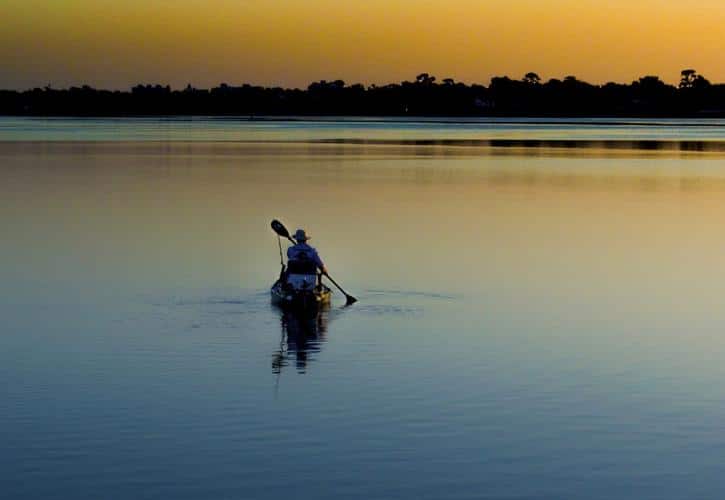
Tomoka State Park is the gateway to the Ormond Scenic Loop, a graceful, picturesque 34-mile ride through history with ancient live oaks dripping with wisteria, subtropical forest, coastal dunes and saltwater marshes that were once home to generations of Native Americans.
A short ride on the Loop takes you to the majestic 400-year-old Fairchild Oak at Bulow Creek State Park, the Bulow Plantation Ruins Historic State Park, a pristine beach at North Peninsula State Park and another state park campground at Gamble Rogers State Recreation Area.
The Loop is a popular Sunday ride, whether you’re on a Harley, pedaling a Schwinn or riding in the family SUV.
Legend of Tomokie
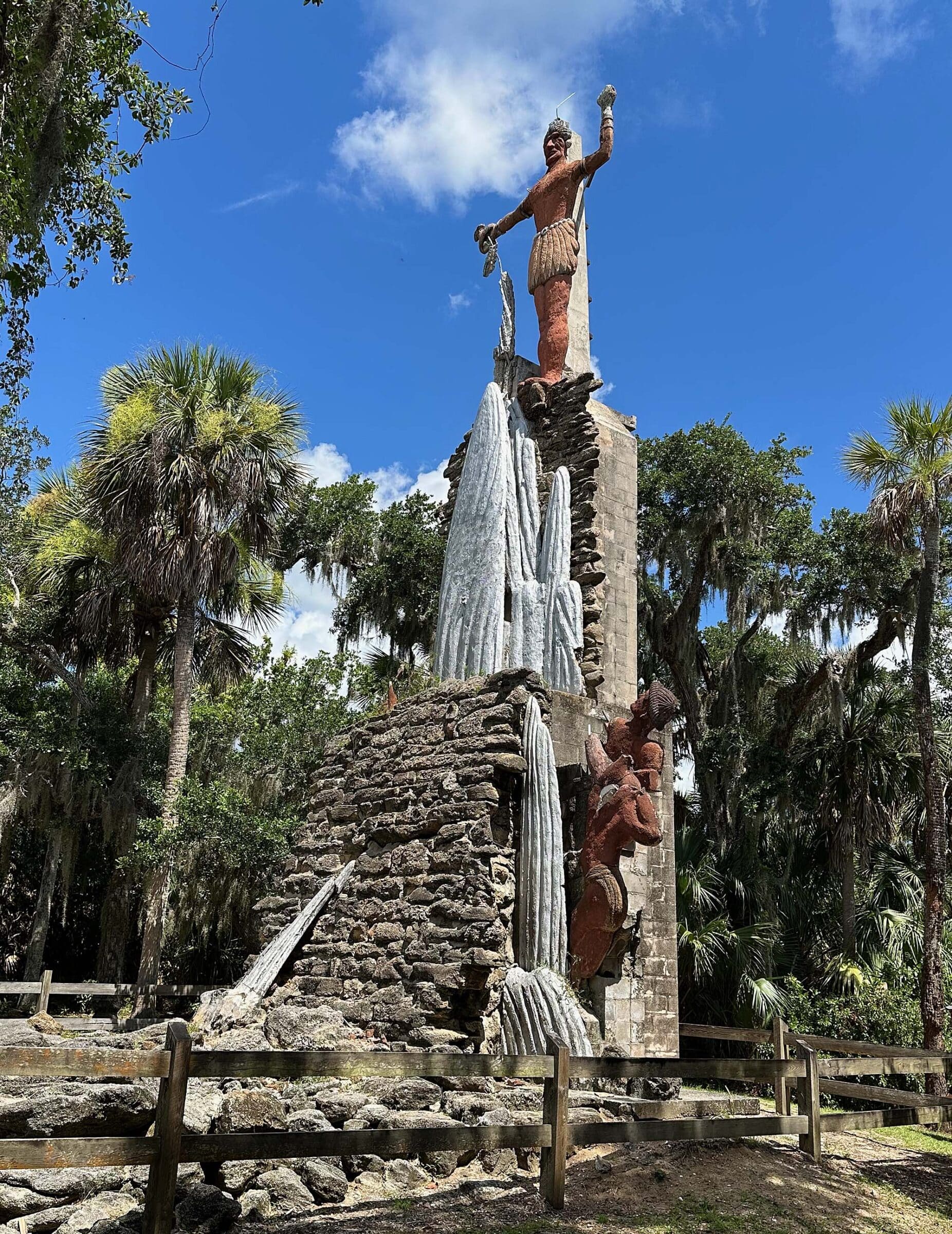
A visit to Tomoka State Park is not complete without paying homage to Timucuan Indian Chief Tomokie, who is preserved in local mythology by a 40-foot statue sculpted by local artist Fred Marsh in the mid-1950s.
The statue is on a pedestal at the northernmost point of the park and is easily accessible from the main park road.
While there may have never been a Chief Tomokie, the monument is a reminder that this area was once populated by Native Americans who lived and fished these waters for centuries before Europeans arrived.
The Timucuan people may have settled here 1,000 years ago in the village of Nocoroco, which was first visited by Spanish explorers in the early 1600s. The explorers wrote that the Timucuan were “of goodly stature and covered in many tattoos.”
Legend propagated by these early Spanish explorers would suggest these Indians stood seven feet tall and were cannibals, but there’s little evidence they were any different than any other.
Nocoroco was one of the largest villages visited by explorers in Florida. The Timucuans lived throughout northeast and central Florida, making them the predominant Native American group in the area.
They most likely settled here because of an abundance of fish, shellfish and wild game that was easily hunted. Archaeological evidence shows the Timucuans were of normal size.
Timucuan tribes were devastated by exposure to European diseases for which they had no natural immunity. By the late 1700s, the Timucua were completely gone.
The campground at Tomoka State Park
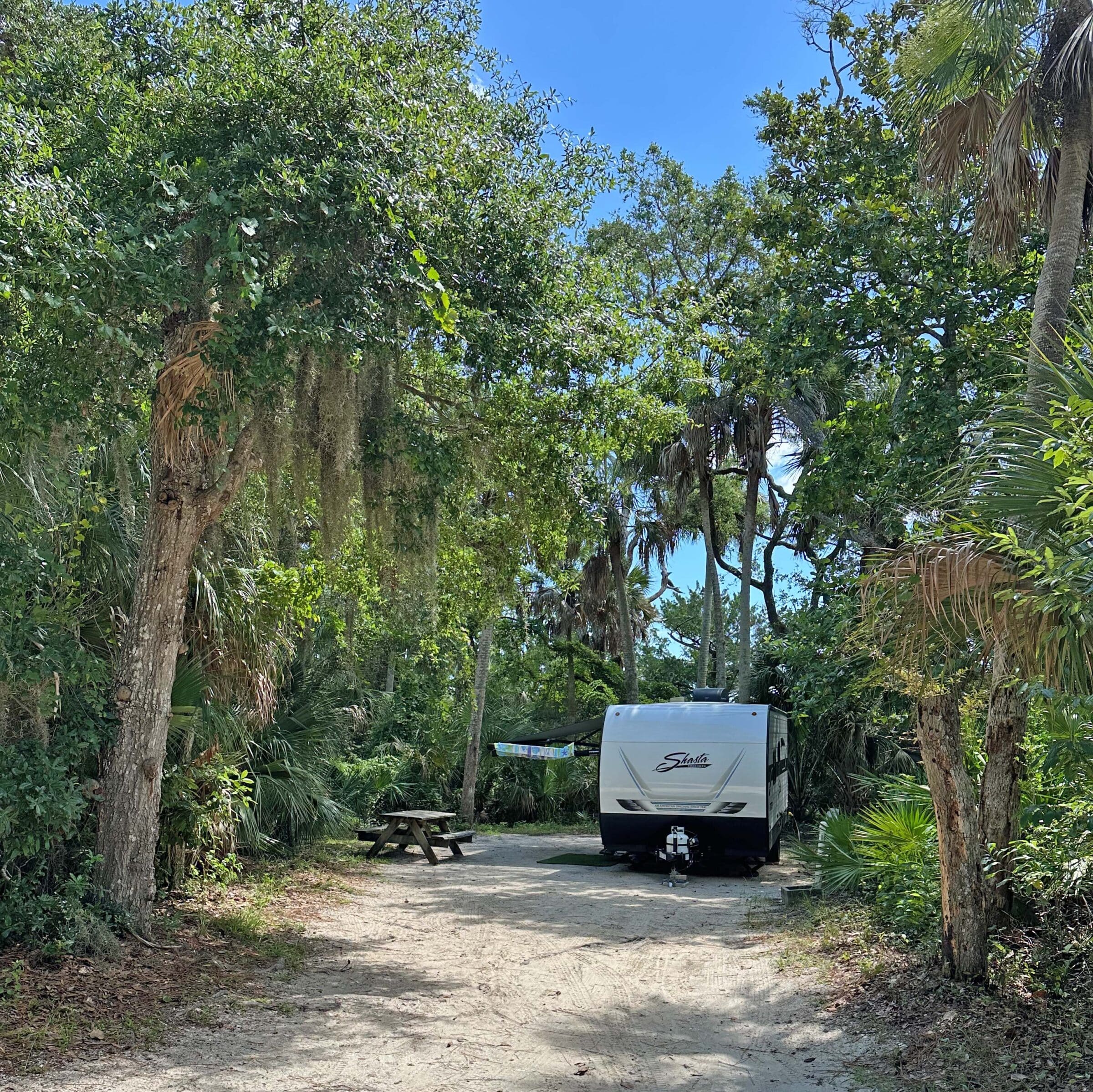
There are 100 well-shaded campsites, and most are deep, spacious and afford considerable privacy. All but a few pads are hard-pack sand and coquina shell, accommodating tents as well as RVs..
Self-supporting tents with a ground cloth will work best, depending on the site you select. For extra strength against surprise weather, tie them off to stakes in softer ground off-site.
Maximum RV length is 34 feet, although many sites look much deeper.
Every site has electric, water, a picnic table, fire ring/grill and a lantern post that can also serve as a clothes line support. (Tie the line to your RV or tent, not to nearby trees.) There are no sewer hookups, but there is a dump station near the campground exit.
Handicapped accessible sites on concrete pads
Site 13 – 20’ with 30-amp service
Site 74 – 34’ with 50-amp service
Site 75 – 30’ with 50-amp service
Site 91 – 34’ with 30-amp service – pull-thru site
The campground, laid out in an elongated oval, has three restrooms with showers. Pets are OK.
Although some sites are a short distance to the water, the river is tidal, making it difficult and cumbersome to launch in the omnipresent soft mud. Plan to use other launch areas in the park.
Because of the intense shade, pooling water and dense thickets of scrub, summer camping can be buggy. Not so much in winter, but you’ll never totally escape the emergence at dusk of pesky no-see-ums.
Be aware of events in nearby Daytona Beach when you set a date for your trip to this park. Reservations will be difficult to obtain during Biketoberfest (October), Rolex 24 (January), Daytona 500 (February), Bike Week (March) and the Pepsi 400 (July 4).
Primitive camping: Want to really get away? There are two primitive camping sites you reach via a several mile hike. Primitive campsites are available for $5. To reserve a primitive campsite, call the park at 863-696-1112.
Paddling at Tomoka State Park

Tomoka State Park is a paddler’s paradise with open water and backcountry trails. The marshes around the park are mostly shallow, so they do not lend themselves to larger boats.
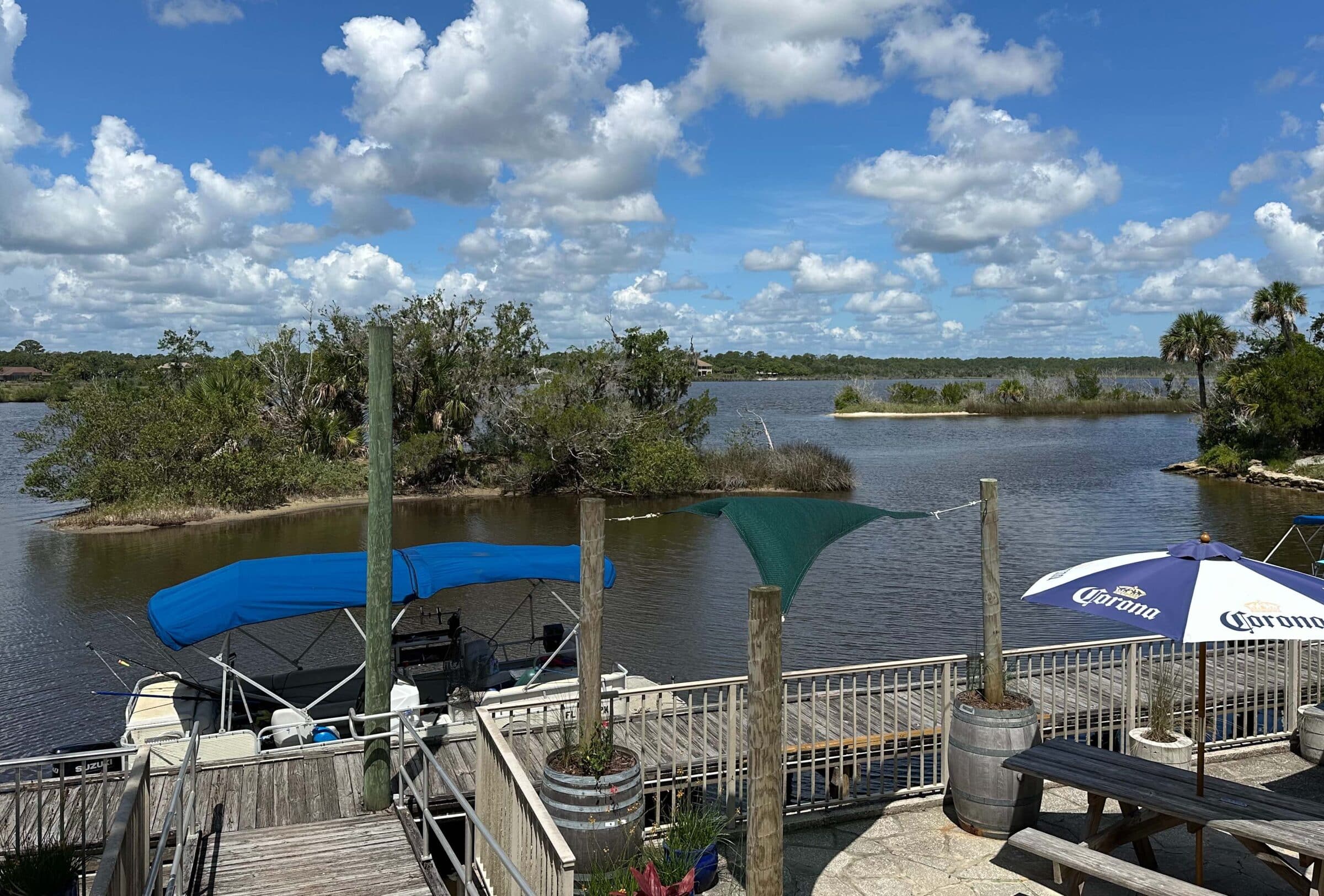
The boat ramp is at the park concession, where you can also rent kayaks and canoes, but you don’t have to launch at the ramp. There is ample shoreline and other launch points around the park’s islands.
But the boat ramp does offer access to the best paddle trails on the Tomoka River, its marshes and upriver creeks that run deep into natural areas of the park, ideal for wildlife viewing.
Hiking and Biking at Tomoka State Park
The number of improved trails within the park are limited, but adventurous souls will be able to explore more deeply if they are into geocaching. Ask for more information at the ranger station.
The only improved trail within the park is a .8-mile interpretive trail that winds through a hardwood hammock once inhabited by Timucuan Indians, including an ancient village site on the banks of the Tomoka River.
The trail starts at the park concession and ends at the statue of Chief Tomokie.
There are many unimproved park roads that are bike-friendly, and a paved multi-use trail at the entrance to the park.
There are several hiking trails at nearby Bulow Creek State Park worthy of attention, including the 6.8-mile Bulow Woods Trail that runs from the 400-year-old Fairchild Oak to the Bulow Plantation Ruins.
This trail will take you through old growth forest of live oaks, and these woods are popping with wildlife.
A short trail takes a loop around a groundwater spring that seeps from a coquina bluff. There are boardwalks on this trail so hikers don’t disrupt the sensitive eco-system.
If you follow the Ormond Loop around to North Peninsula State Park, you’ll find a two-mile-long Coastal Strand Trail that will take you into the coastal dunes, where you can observe a variety of unexpected wildlife, such as shore birds and gopher tortoises.
The Ormond Scenic Loop and Trail
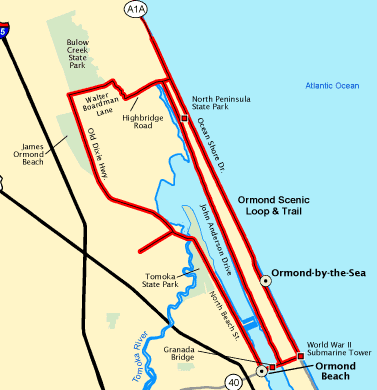
This 34-mile double loop of roadways between Ormond Beach and Flagler Beach passes through three state parks and several county parks and preservation areas, stitched together into a scenic drive in the country with spectacular views.
Bicyclists tackle these roads with enthusiasm, but be forewarned that the roads are narrow and cars not always respectful.
The Ormond Loop is popular for motorcycles, and you’ll find it packed with bikers during special motorcycle events in nearby Daytona Beach. Signs frequently remind riders to limit noise.
What’s the attraction? Simply, the views.
The Ormond Scenic Loop is one of the most picturesque destinations in northeast Florida, passing through canopies of live oaks and dense hardwood forests, sweeping grass savannas and saltwater marshes, coastal dune eco-systems and pristine beaches.
The double loop starts on North Beach Street at Tomoka State Park, continues north along Old Dixie Highway, then jogs east on Walter Boardman Lane, jogging south then east on Highbridge Road until you cross the Intracoastal Waterway at High Bridge.
Immediately after crossing High Bridge, turn south onto John Anderson Drive and cruise alongside the Halifax River, eventually dipping into bustling Ormond Beach before swinging east to State Road A1A.
Heading north along the beach, you will be greeted by gentle sea breezes and the pristine dune environment of North Peninsula State Park.
The loop ends back at Highbridge Road, but it will be worth your while to continue north on A1A through Gamble Rogers State Park to Flagler Beach, an old Florida beach town with tons of character.
Tomoka State Park, 2099 N Beach St., Ormond Beach. Phone: (386) 676-4050. Day-use visitors: $5 per vehicle. Kayak, canoe rentals available at the park concession, Tomoka Outpost. Boat ramps. Camping: 100 campsites with water, electric hookups, dump station. Pets OK. Camping fee: $24/day plus $7 daily utility fee for RVs (not tents). Reservations: Florida residents can book online up to 11 months in advance (10 months for non-residents) at reserve.floridastateparks.org or call (800) 326-3521.
Discounts: Florida residents age 65+, as well as residents who are certified disabled, receive 50% off the base campground fee. Reservation fee ($6.70) and utility fees ($7) are not included in the discount.
Dining out
There is at least one night on a camping trip when you’re tired of grilling over the campfire and you need to get out. You are in luck. In fact, you may be luckier than you think.
Hulls Seafood Restaurant, 111 West Granada Street, Ormond Beach, 32174. Map.
The seafood is fresh off their own boats, and they sell it in their own market. The market fronts on Grenada Street and the restaurant is behind the market. Park out back if you can, and there are a couple of public lots nearby behind the Grenada Street storefronts,
The atmosphere at Hulls is classic Florida seafood shack, the staff is friendly, and the seafood is among the best I’ve ever had, Make sure you get their crab cakes, and don’t forget to pick up their smoked fish dip for snacking back at the campsite. Very fresh.
To get here from Tomoka State Park, turn left from the park entrance onto North Beach Street; drive four (4) miles to Grenada Street. Turn right, and Hulls is two blocks up on the right,.
You also might like:
Grind at Kona Tiki Bar, 49 W. Granada BLVD, Ormond Beach, FL 32174. Touristy setting with “backyard” outdoor bar and dining, one block east of Hulls. Hawaiian-themed menu and pizza. Phone: 386-672-7277
Related Stories on Florida Rambler
Bulow Plantation Ruins: Romantic ruins, picnic & walk
9 things to do near Daytona Beach
This park is just a kaoke, a miracle of nature, an amazing place, it was interesting to read the overview of Tomoka Park. My wife and I love camping and went there a couple of times, the place is very quiet and calm, everything is neat, not many people. An ideal place to spend time together. We walked and bicycled along these interesting paths, a terrific place. Have a nice day!