
Our sub-tropical climate is glorious much of the year, but tent camping in Florida during the summer can test your limits because of overwhelming humidity.
Here are 8 hot tips to help make your tent camping experience bearable, especially during Florida’s blistering summer months.
Double tent capacity
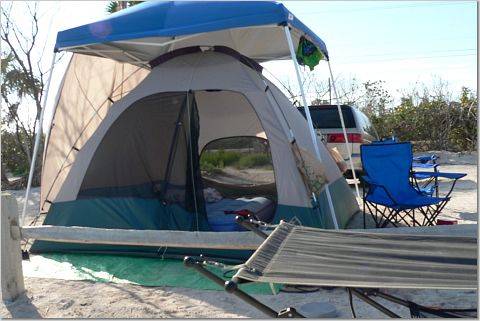
The cardinal rule for Florida tent camping is a tent at least double the capacity you need, especially in summer. The reason is circulation. More space, more air.
If there are two of you camping, get a four-person tent. Four of you? You want a tent that sleeps eight.
Be sure you have cross-ventilation. Your tent should have a screened door or window on all sides with extra-fine screens to keep out pesky no-see-ums and mosquitoes.
Find and create shade
When selecting a campsite, shade is your top priority. A shady campsite near water is might even generate a refreshing breeze.
If natural shade isn’t available, create your own. A tarp or pop-up canopy creates a breezeway space between the roof of the tent and the canopy. The canopy will also deflect rainwater from the surface of the tent and reduces condensation inside the tent.
Use tie-downs on your canopy so it doesn’t blow away in a sudden burst of wind.
A tarp packs small and flat, and it serves multiple purposes. I remember an expedition on the Peace River one year when a storm popped up out of nowhere. We paddled to the riverbank and rolled out a lightweight tarp and draped it over our heads and kayaks until the storm passed.
Use a raised cot if you can
If you’ve got room in your tent, camping cots allow air to circulate around your body, cooling you down.
Not only are they cooler, a cot also keeps you off the ground and above flooding in Florida’s frequent summer storms. (Florida’s wet season starts in mid-May and continues until mid-October.)
On one camping trip, my wife and I were sleeping on air mattresses when a severe storm popped up in the middle of the night. The tent flooded, and we got soaked. It was actually worse than that: We were on a hillside in Georgia and the tent floor was sloppy with red clay.
Lighweight sleeping bag or sheet
Even the most lightweight sleeping bags trap heat, so a plain bedsheet may be all you need when camping in Florida this summer.
If you must have a sleeping bag, buy one that is lightweight and designed for summer use.
Bring plenty of water
Staying hydrated is critical for summer camping, so bring plenty of water.
Instead of freezer packs, freeze gallon jugs of water for your cooler before you go. Not only are they good for keeping your food and drinks cold, they serve as a bonus water supply as the ice melts.
Portable fan
A portable battery-powered fan is an excellent idea, though you may be shunned by the purists.
If you already use Ryobi One battery-powered tools, then picking up the Ryobi One 18-volt fan at Home Depot ($59) is a no-brainer. If you don’t already have the Ryobi One system, you’ll want the whole package of fan, battery and battery charger for $129.
If you have an electric hookups at your campsite, then any electric fan will do.
Sunscreen
When you are outside in the Florida sun, those ultra-violet rays sneak up fast, even on a cloudy day. Pack SPF 50 for the best protection, certainly no less than SPF 30.
If you are camping in the Florida Keys or anywhere in coastal Florida where you plan to swim, use a reef-safe, climate-friendly sunscreen such as Blue Lizard, which does not contain the chemicals oxybenzone and octinoxate.
Bug repellent
When the sun sets, swarms of mosquitoes and no-see-ums can be frightful.
Legions of campers swear by Avon Skin-So-Soft, but I recommend these two solutions:
- A portable Thermacell Portable Mosquito Repeller, which produces a non-toxic cloud that repels mosquitos for a 15-foot radius. You can even carry it in a holster while hiking.
- Repellents containing either DEET for your body or permethrin on your clothing. One of the best DEET repellents is Deep Woods Off.
Do you have a hot tip? If you have a suggestion for summer camping, share it with the rest of us in the comments below.
This feels so real and relatable… I could almost feel that heavy heat and sticky air while reading. The tips are practical and honest, especially about space and airflow in the tent. Makes me both excited for the adventure and a little nervous about the challenge, but in a good way.
In Summer, only camp by water (ocean, big river). Nice breezes come off the water. And I do use an electric or battery tent fan.
What wonderful tips! Here’s another thing I’ve learned about summer camping: Get the kids (and yourself) back in “it’s a school night” mode before you go; in other words, go to sleep early and get up with the sun to enjoy those early morning hours of lower temps. AND to avoid the unpleasant experience of waking up sticky in an airless tent once the sun is well up. Cheers, and happy camping! (Perhaps everyone already does this, but I thought I’d share, just in case!)
Excellent suggestion, JoLee! Thanks for sharing! :-)
— Bob Rountree, co-publisher