
Editors Note: Everglades National Park‘s Gulf Coast Visitor Center in Everglades City, as well as the center’s new kayak launch, has reopened, The Visitor Center is open daily from 9 am to 5 pm.
Viktorwills, <https://creativecommons.org/licenses/by-sa/4.0>, via Wikimedia Commons)
Tides are constantly moving through the Ten Thousand Islands, going out even as they are coming in. The currents are constantly changing direction, or so it seems, and that’s disorienting for kayakers who paddle off the main channel, Indian Key Pass.
Even in the pass, a clearly marked extension of the Barron River through the mangrove islands, the current moves so fast at peak tides, it ripples the surface of the water as it rushes through.
Timing is everything if you are planning an expedition into these waters. Check tide tables in advance and plan your adventure, especially important for a day paddle out to Indian Key from Everglades City.
You want to leave Everglades City on the outgoing tide and return with the incoming tide.
Launching your kayak
Your paddle begins at the Everglades National Park visitor center in Everglades City.
The boat ramp is on the north side of the visitor center, next to the kayak rental concession building.
Whether you are going out for the day or camping overnight, if you plan to park, you will need to purchase a National Parks entrance pass for $35 (good for 7 consecutive days) or have an annual pass in your possession.
If you are planning to camp, you will also need a backcountry camping permit ($21, plus $2 per person per night).
The paddle trail I’m suggesting is especially good for first-timers. You will paddle out through the well-marked Indian Key Pass, the main channel from the mouth of the Barron River in Everglades City to the Gulf of Mexico.
Take the Boat Tour — If this is your first time, you may want to scout the pass by taking the tour boat that embarks out of the Visitor Center Marina for a 1-1/2 hour cruise to Indian Key.
Head out for Indian Key Pass
Indian Key Pass is well-marked. From the Visitor Center, paddle northwest across Chokoloskee Bay from the ramp to the channel markers at Indian Key Pass. You are likely to see boat traffic in the channel as you cross the bay.
In an ideal world, you should start this trip shortly after high tide from Everglades City.
Once you are in the channel, paddle leisurely with the outgoing tide, following the channel markers for 4-1/2 miles to the end of the pass at Indian Key.
Stay on the outside of the channel as much as possible to avoid motorboat traffic, which is generally light but can be alarming when boats come speeding around the bends.
You will see a few bays along the channel worth exploring, but don’t lose sight of the channel markers. If you do stray further, it’s a good idea to have a waterproof GPS and a NOAA navigation map for the Ten Thousand Islands so you can chart your trail and waypoints to find your way back.
The park concession offers guided kayak tours. For more information, go to evergladesnationalparkadventures.com
Even with a map, it’s easy to get lost in these islands. They all look the same, and what may look like an easy pass to explore can quickly turn into a miserable day and night trying to find your way out. This is also a good reason to leave a float plan with the rangers at the Visitor Center.
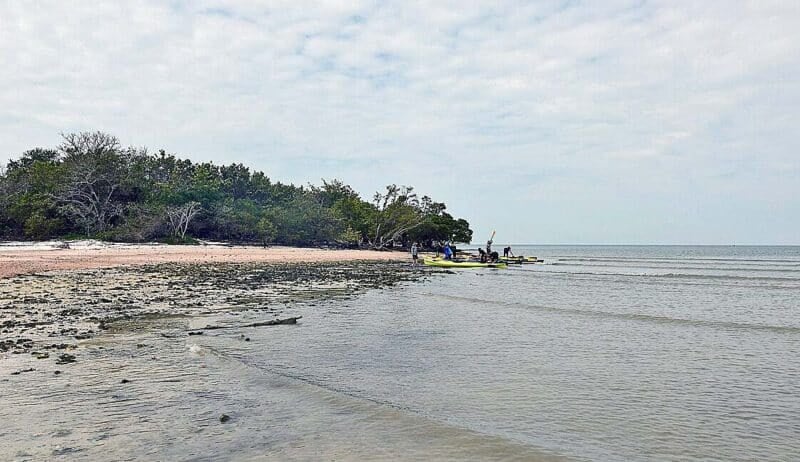
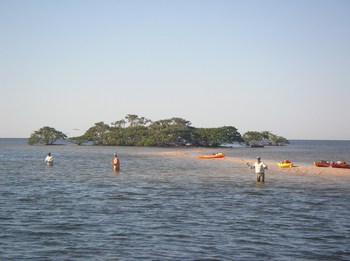
Once you have reached Indian Key (N: 25.8090 | W: -81.4657) at the end of the channel, stop for a picnic and relax on the beach and sandbar until the tide turns, then ride the incoming tide back through Indian Key Pass. You can watch the tide rise on the Indian Key sandbar.
Paddling against the tides is doable, but it can be tough going.

Island camping
Wilderness campsites within the boundaries of Everglades National Park are about a mile north of Indian Key Pass at Tiger Key (N: 25.8322 | W: -81.4907) and Picnic Key (N: 25.8231 | W: -81.4851).
Picnic Key has a vault toilet accessible to both islands. There is an unmarked channel between the two islands that will take you out of the wind. Another option within the park is to venture south of Indian Key to a campsite at Jewell Key. Jewell Key (N25 47.320 | W81 25.106) is about 3.5 miles south of Indian Key Pass.

Camping permits are required within the boundaries of Everglades National Park, but you can camp without a permit north of Tiger Key in the Ten Thousand Islands Wildlife Refuge.
Directly across West Pass from Tiger Key is a popular destination known as Camp Lulu Key, or paddle another three miles northwest to Panther Key (N: 25.85204 | W -81.545892). Both islands are outside the boundaries of Everglades National Park where permits are not needed.
This is a wonderful trip, especially if you camp overnight. The island beaches are natural, beautiful and isolated.
Permits for primitive camping in the Ten Thousand Islands are available up to three months in advance at Reservations.gov. There is a one-time $21 administrative fee plus an additional $2 per person, per night use fee for camping on Tiger Key, Picnic Key and other islands within Everglades National Park.
Camp for Free and without permits or restrictions north of Tiger Key in the Ten Thousand Islands National Wildlife Refuge. Read this story about camping on Panther Key.
On New Year’s Eve, campers gather for an annual celebration at Camp Lulu. You can see the fireworks from Tiger Key.
Supplies and other resources
Across the street from the ranger station is a deli where you can buy food and supplies for your paddle. This is a regular stop for us. The store also serves food, beer and wine outdoors in their screened patio. Kayak and canoe rentals are available, as well.
In Everglades City, at marinas along the Barron River, and on Chokoloskee Island, there are many fishing guides and airboat tour operators who will take you into the backcountry for some incredible experiences.
Weather Tip! Storms in the islands are truly unpredictable at any time of year. Be prepared. Carry a rain parka if you’re paddling, and if you’re camping, make sure you have a waterproof tent that will stand up to stiff gusts of wind.
Places to stay in Everglades City
Glades Haven Cozy Cabins are across Route 29 from the ranger station, next to the store,. There is a boat ramp for motorboats, if you bring one, although you would still want to launch kayaks and canoes at the ranger station.
For other lodging, try the historic Everglades Rod and Gun Club or Ivey House.
RVers may want to set up their base at Outdoor Resorts of Chokoloskee Island, about a mile south of the ranger station, off the causeway at the entry to Chokoloskee. Call (239) 695-2881 or E-mail to orachokoloskee@aol.com for pricing and information.
Chokoloskee Island RV Park. This rustic park has a marina, restaurant and bar. RV sites run $100+ per night in peak winter season. Dockage is also available.
For tent campers (and RVers) looking for a land base in a more natural setting, try Collier-Seminole State Park, about 15 miles north of Everglades City on Tamiami Trail. This state park has its own kayak trail, fantastic off-road bike and hiking trails and 118 well-groomed campsites. On display in the park is a huge dredge that was used to build the Tamiami Trail across the Everglades.
Related articles
- Smallwood’s Store and Museum
- Beach Camping in the wild Ten Thousand Islands
- Collier-Seminole State Park
- Stone Crabs in Everglades City
- Everglades City: Kayak Historic Village
- Scenic Drive: Tamiami Trail
Things to do nearby
- Ochopee Post Office: Smallest in US
- Scenic drive across Florida via Tamiami Trai
- Shark Valley area of Everglades National Park: Excellent trail for bicycling and wildlife viewing in Everglades National Park
- Clyde Butcher’s Big Cypress Gallery
- Big Cypress National Preserve
- Fakahatchee Strand Preserve State Park
How long does this take, assuming you’re going with the tides?
Rich,
With winter’s short days, you’ll use up a lot of daylight, so start as early as you can. Figure at least 2-3 hours each way, and you’ll want some breaks.– Bob