
Last updated on January 21st, 2026 at 03:37 pm
Spoil Island is an ugly name for what turns out to be a terrific kayaking destination.
The Indian River Lagoon has more than 150 spoil Islands — places where you can land, explore, relax, swim, picnic, watch the wildlife or even camp. There is no fee and no reservations are required.
The lagoon is an estuary that parallels the Atlantic coast for 156 miles, from the Jupiter Inlet in Palm Beach County to the Ponce de León Inlet in Volusia County.
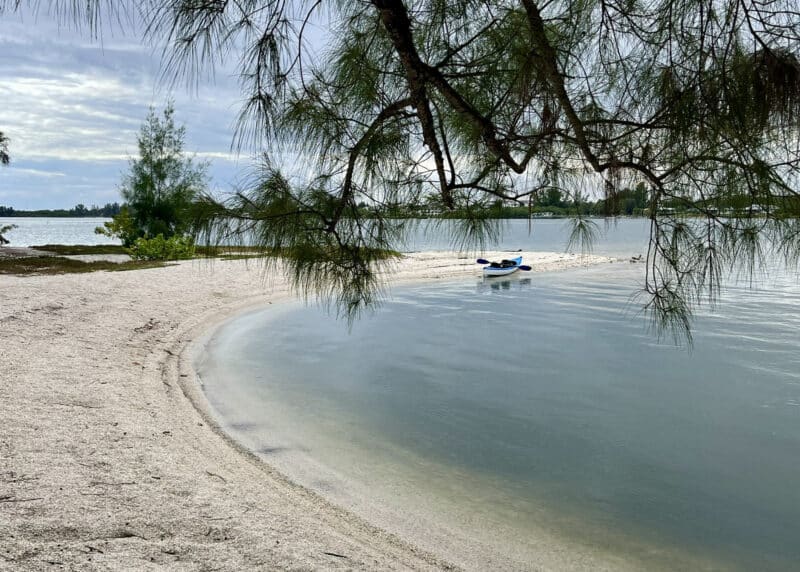
The islands were created in the 1950s during the dredging of the Intracoastal Waterway. Today, they fulfill that universal desire to escape to an island that can be all yours for a while.
You’ll feel like you left the urban world behind. Of course, you are also leaving behind such conveniences as running water and sanitation. To picnic or camp here, you must bring everything, and that includes your own “toilet,” the contents of which you have to pack out. (No digging a hole for it.)
Wildlife is abundant on the lagoon and a few of the islands are designated as “conservation islands,” where nesting birds are protected and camping is prohibited.
Planning a kayak outing to a spoil island
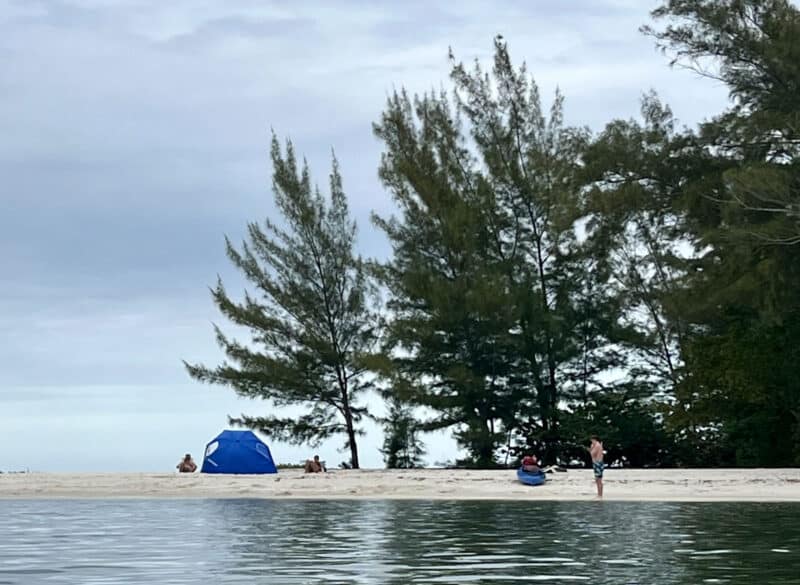
You can travel by kayak or motorized boat from many locations along the lagoon and head for any number of islands. Most of the spoil islands are in the central Indian River Lagoon between Fort Pierce and Melbourne. We haven’t paddled to all of the islands, but we certainly liked kayaking to the islands off Sebastian.
While each is unique and fun to explore, the islands are essentially similar — they are dominated by Australian pines, which cast welcome shade although they are an unloved exotic species, plus palms and mangroves, which help stabilize the islands.
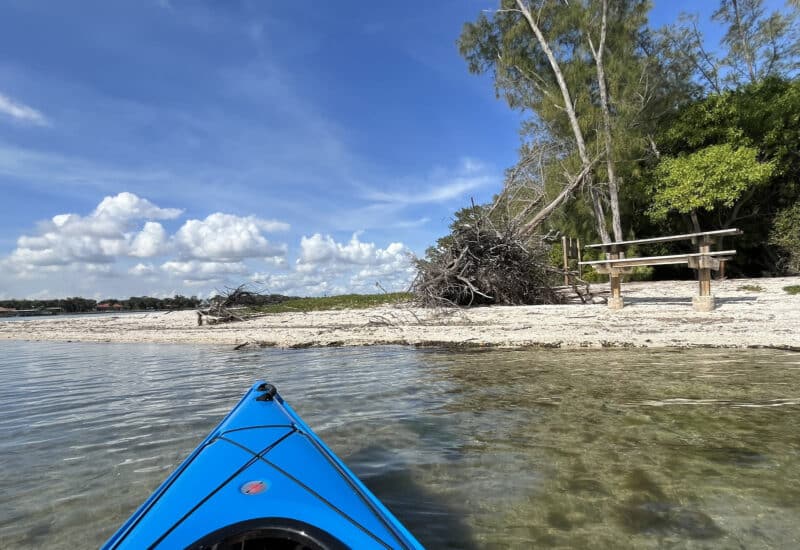
Some of the islands have picnic tables and fire rings; none have trash baskets, water or toilets. The extent of sandy beach areas on each island varies a lot. Some of the most appealing islands have long sandbars that attract birds.
It is the wildlife that made our paddles to the spoil islands so memorable. Dolphins are commonly seen cruising in the Indian River Lagoon, which is home to a resident population of about 1,000 bottlenose dolphins. Manatees can be seen too, especially in winter.
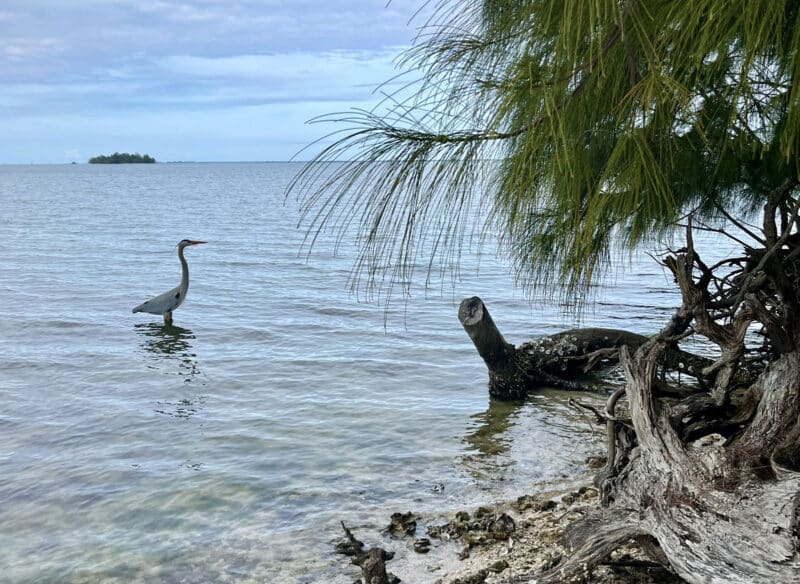
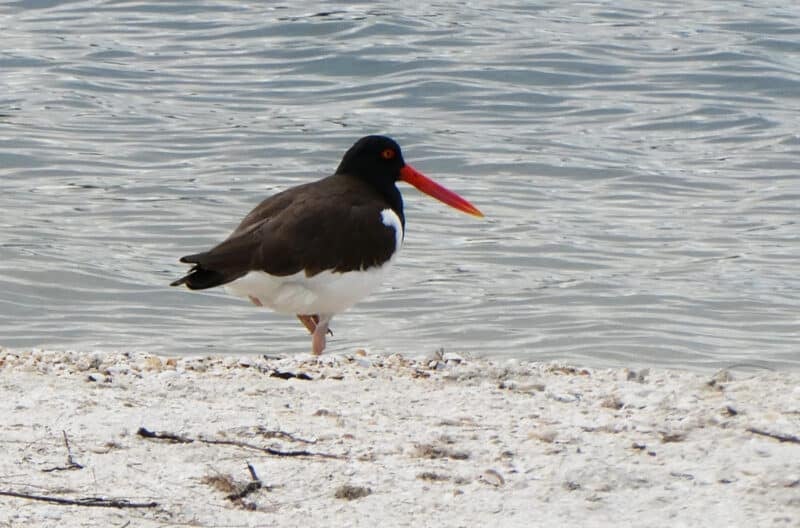
Wading birds, such as various herons and egrets, are common, as are ospreys hunting, diving and nesting. Brown pelicans are plentiful and big beautiful white pelicans are a common and striking sight in winter. Shore birds like terns, gulls and oystercatchers are easy to see.
If you’re thinking about a spoil island adventure, this map of the Spoil Islands in Indian River Lagoon is essential.
Camping on a spoil island
One thing we find remarkable about the spoil islands is that you are welcome to camp on these islands and there is no fee or reservation system. The islands are owned by the State of Florida.
Campsites are on a first-come basis. On a busy weekend, if you find the first island already occupied, you might have to paddle to the next one.
In your preparations for an overnight stay, look into Wag bags, specially designed bags for sanitation in just these circumstances, or an inexpensive portable toilet like this.
Here’s a detailed guide to primitive camping on the Indian River Lagoon spoil islands by my colleague Bob Rountree. It includes maps and tips.
Where to paddle
We’ve kayaked to spoil islands from both Fort Pierce and from Sebastian, an hour further north. We liked Sebastian because of the variety of islands you could see and explore in a half day of easy paddling without long sections over open water. I’ll make a few additional suggestions at the end.
Spoil islands near Sebastian: Many choices; easy access
We spent four hours kayaking to and around about a dozen nearby spoil islands, covering about six miles round trip. We launched from a terrific cottage complex where we stayed, Island View Cottages, 11450 S. Indian River Drive, where it’s a 10-minute paddle to the nearest island, IR9A.
From there, we were able to paddle south past and around a string of islands (IR9B, IR10, IR11, IR12, IR13 and IR14). All are recreational islands with appealing beaches and shade. (Note: Spoil Islands are designated with the county’s initial and then a number, so islands starting with IR are in Indian River County.)
We picnicked on IR14, which had a picnic table in the shade, a long scenic sandbar and nobody else around. There was not a single piece of trash. The downside: Only a quarter mile away on the mainland there are boxy condo buildings that spoil the illusion of being in the wild.
The nearest islands south of IR14 are conservation islands and we did not visit them.
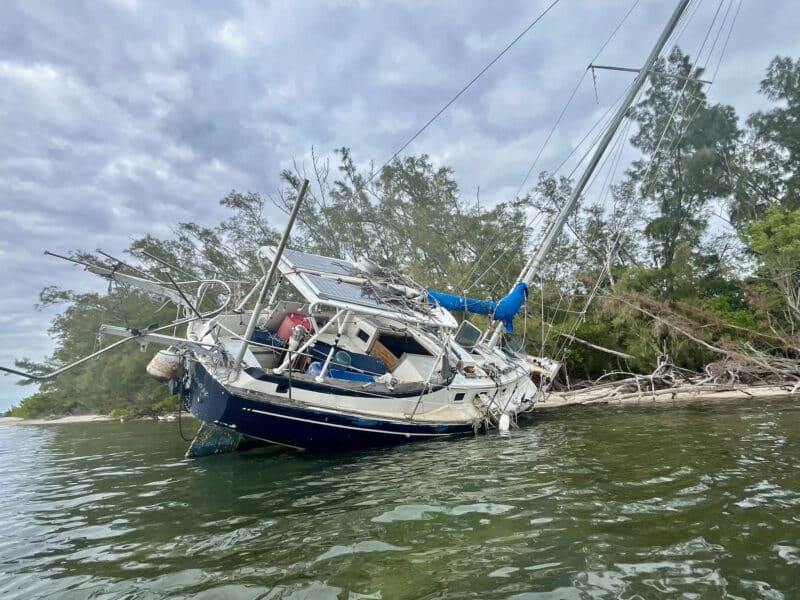
From IR14, we paddled north again, passing IR8, a conservation island, and on to IR3 and IR2, where we wanted to get a closer look at a wrecked sailboat on its beach.
Renting and launching from Sebastian: There are a lot of places to rent jet skis and pontoon boats, but the only kayak rental spot we could find was from Capt. Hiram’s Resort. Our accommodations, the Island View Cottages, had several kayaks available for guests at no charge and you could launch directly from the resort’s grounds. If you bring your own kayak, a convenient launch is Sebastian’s Main Street boat ramp, though it is busy with power boats launching.
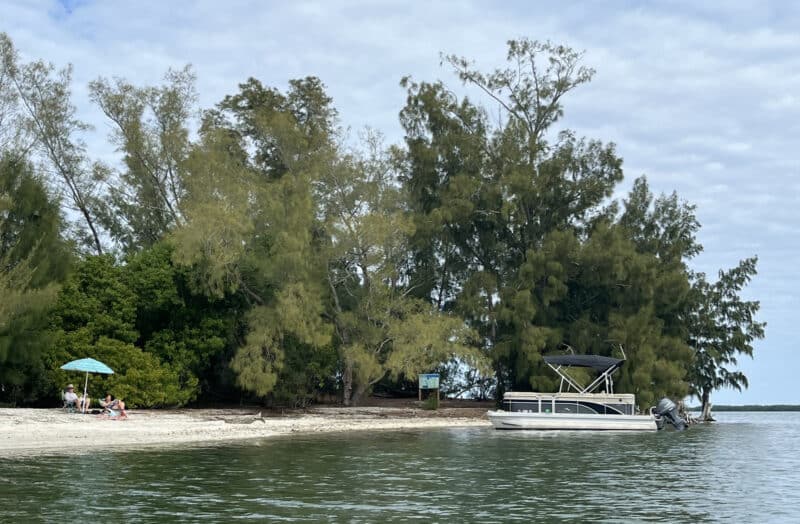
Spoil Islands near Fort Pierce
For our spoil island outing from Fort Pierce, we put in at the North Causeway Bridge Park boat ramp, 500 North Causeway Drive, Fort Pierce. We had our own kayak, but you can rent kayaks and stand up paddle boards from Lisa’s Kayaks at this location. (Note they are closed Tuesday and Wednesday.) Rates are reasonable and Lisa provides a map for an appealing two-hour kayak trail from the location.
North Causeway Park is a good place to launch because it is close to the spoil islands plus it has restrooms and a picnic table. From here, island hopping requires paddling over only short stretches of open water. (Always watch the weather and be careful of windy or choppy days.)
Before we even left the boat dock, a dolphin swam directly across our path. The first island we reached had dozens of brown pelicans roosting in the mangroves. Ospreys squealed overhead; kingfishers darted here and there. The scenery was wonderful.
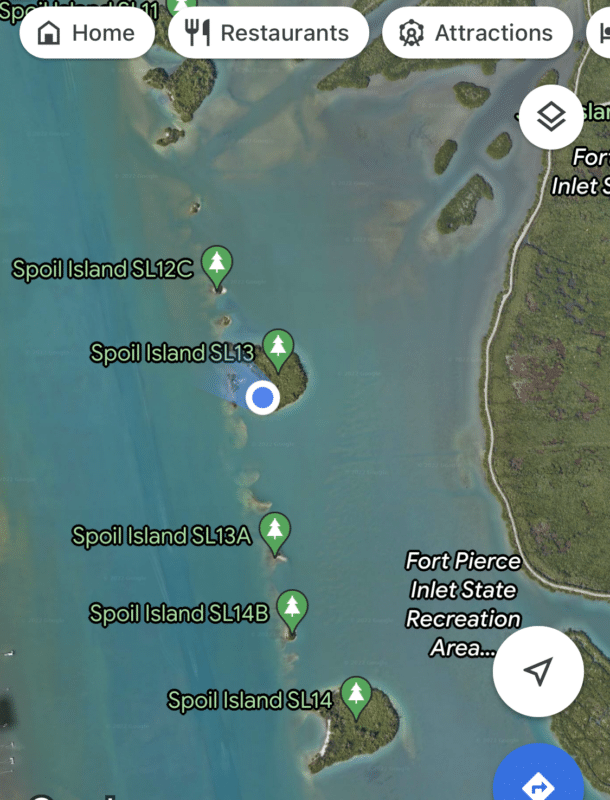
Our first stop was SL14, which is designated a conservation island, so we limited ourselves to its pretty sandy beach and a well-worn trail. (We did note, however, tents and a campsite set up on the east side of the island. Camping is discouraged here. Enforcement is by the Florida Fish and Wildlife Conservation Commission, but it’s obvious that it is difficult to enforce the rules.)
A short paddle north was our real destination, SL13, the closest designated recreation island. To reach it, you must paddle 1.3 miles from the causeway, past nine islands. If you paddle another 1.6 miles, you reach the next recreation island, SL8. North of that island there are a half dozen more recreation islands fairly close together.
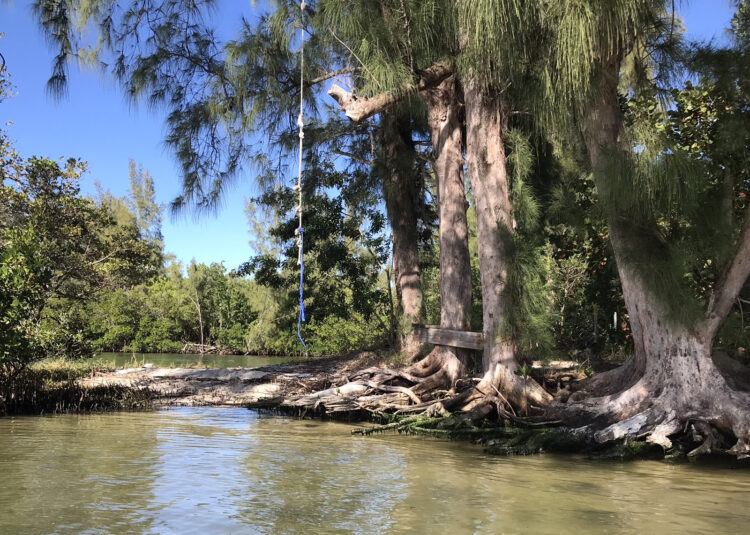
We found SL13 to be an ideal private island still unclaimed for that Thursday night. The island has a sandy beach protected by a small mangrove island nearby, which created a little private cove. On one side a rope swing hung; someone even built a wooden platform where you could stand before swinging off and dropping into the water. (The worn rope and shallow water suggested caution.)
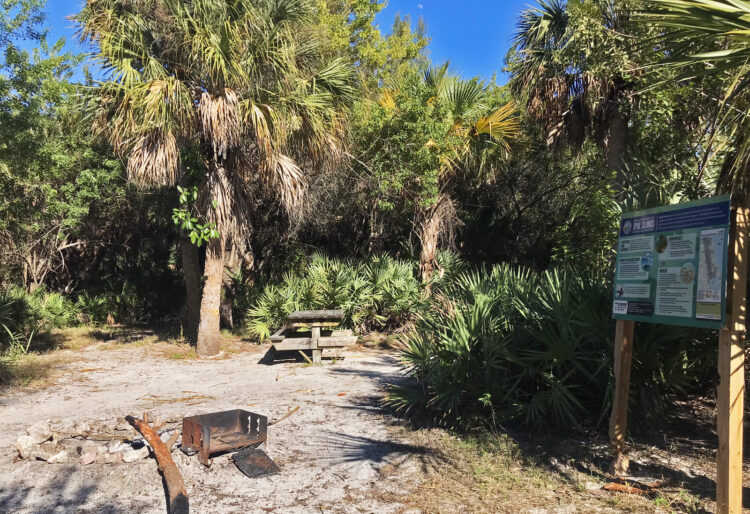
The island was equipped with a fire ring and picnic table (missing one of its benches). Off in the woods was a toilet seat attached to a box, definitely not an approved installation. Despite the appearance that this could be used as a latrine, you still need to use plastic bag inside it so that you remove all your waste.
The fire ring was well used; I’m sure this island is popular with the many power boats.
Other spoil islands to explore
Other possible spoil island kayak outings (among many options you’ll find once you start exploring via Google maps):
Between Fort Pierce and Vero Beach: John Bacon, president of the Friends of the Spoil Islands, pointed out that SL3, across from the FAU Harbor Branch Oceanographic Institute in Fort Pierce, is ADA accessible with wheelchair mats and amenities to help those with limited mobility to enjoy the islands. (Most likely, this would be for people arriving by pontoon boat or similar.) There is a kayak launch at FAU Harbor Branch. You can reach five more spoil islands (SL4-8) with two miles of kayaking south of here. SL8 is particularly popular for groups as there is open space to spread out several tents.
North of Vero Beach: 69th Street Kayak Launch, 2674 69th St., Vero Beach, is a popular launch spot for paddlers and fishermen. It’s only 500 feet to a natural island, Hole in the Wall Island, known for good fishing in its surrounding waters. After that it is less than two miles of kayaking along a series of small islands (North Sister, South Sister, Lee islands) until you reach IR25. It’s an unusual spoil island because it is larger and has a dock and trails.
Off Vero Beach: From the Oslo Road boat ramp, 200 9th St. SE LOT 258, Vero Beach, it’s a third of a mile to IR39 and a mile in total south to IR40 and IR41. North of IR39, a mile of paddling will take you to IR38 and IR37. All of these islands are open for camping and exploring.
For trip ideas, here’s ann interactive Google map of the Spoil Islands in Indian River Lagoon
Here are PDF maps for each county’s spoil islands:
Is the Indian River Lagoon still in bad shape?
While it is still beautiful and full of wildlife, the Indian River is not entirely healthy.
In 2019 and 2020, toxic algae blooms in the lagoon were national news. There had been bad algae blooms in previous years (2011, 2012 and 2016.) The algae blooms resulted in extensive seagrass loss and more than a thousand manatees died in the winter of 2019-2020.
There has been a modest improvement in conditions since then, but the health of the lagoon is ranked as only “okay.” Still, the central lagoon had been ranked “poor” in previous years, so “okay” is an improvement.
Multimillion dollar projects are underway to improve wastewater and stormwater infrastructure, which are key sources of pollution to the lagoon.
Plan your visit to the Indian River Lagoon with these stories from Florida Rambler:
- Navy Seal Museum
- Explore Hutchinson Island and A1A
- Snorkeling: Bathtub Reef Park and more Florida locations
- Archie’s on Hutchinson Island: No Shirt, No Shoes, No Problem
- McKee’s Botanical Garden in Vero Beach
- Beach horseback riding: Check these off your bucket list
- Kayaking St. Lucie River waterways: Many kayak trails to explore
- Elliott Museum, a fascinating collection of old cars, antiques and local history in a spiffy setting.
- Gilbert’s Bar House of Refuge, a historic treasure, this is the last house of refuge of 10 originally built along Florida’s coast to aid shipwreck victims.