

The regular Florida spiny lobster season opened on August 6 for both recreational divers and commercial trappers in South Florida and the Florida Keys.
Commercial lobstermen have already put out their traps, and they are now starting the harvest their catch and ship them to stores and restaurants.
Are you getting read to catch, cook or eat Florida Lobster?
Here’s your unofficial primer.
August 5-9, 2026 — Key West Lobsterfest. Key West Lobsterfest returns this year after taking a break in 2025. And this year it was moved closer to the opening of the regular lobster season. Proceeds support the Key West High School Scholarship Fund, For more information, go to keywestlobsterfest.com
Where do you find Florida lobster?
Florida lobster, also known as the Caribbean spiny lobster or the West Indies spiny lobster, inhabits tropical and subtropical waters.
They are prevalent in the Keys but can also be found on offshore reefs in Dade and Broward counties and in limited areas of the Gulf of Mexico.
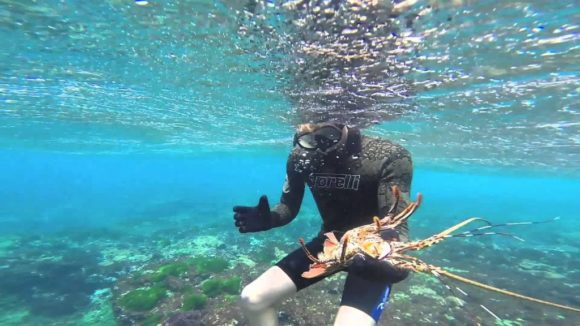
Two large, cream-colored spots on the top of the second segment of the tail make spiny lobsters easy to identify. They have long antennae over their eyes that they wave to scare off predators and smaller antennae-like structures called antennules that sense movement and detect chemicals in the water.
It’s those smaller antennules, which extend forward below the eyes, that alert the lobster to approaching danger, causing it to scoot under rocks and coral outcroppings to hide, if they are not there already. The spiny lobster tends to spend daylight hours in hiding, emerging at night to feed.
So that’s where you look. Around structure.
With your “tickle stick”, find the lobster in their holes and slide it behind the lobster, urging him out of hiding. Once out of their hole, place your net behind the lobster’s tail and tap it on the head with the stick, prompting it to propel itself backward into the net.
It’s important to remember that the Florida lobster moves backward. Quickly.
Keeping it in the net is another matter. Adding to the challenge is the legal requirement to measure the lobster before you take it out of the water. Use gloves. You will undoubtedly lose a few of those feisty rascals before you get it right.
The daily recreational limit in Monroe County (which includes the Keys) is six (6) lobsters, whether it’s mini-season or the regular season. The bag limit during mini-season for the rest of the state is 12 but drops back to six for the regular season. These limits are strictly enforced.
Keep it legal
Expect to see state and federal Fish & Wildlife officers, park rangers, state troopers and county sheriff’s deputies at boat ramps and on the water, patrolling prohibited areas as well as legal dive spots.
Prohibited Areas: Spiny Lobster Sanctuaries
- John Pennekamp Coral Reef State Park, Key Largo
- San Pedro Underwater Archeological Preserve State Park, Islamorada
- City of Layton, Long Key
- Dry Tortugas National Park
- Everglades National Park
- Ten Thousand Islands National Wildlife Refuge
- Biscayne Bay/Card Sound Lobster Sanctuary
- No-take areas in the Florida Keys Marine Sanctuary
Don’t go without a fishing license and lobster permit
You are required to have a saltwater fishing license AND a lobster permit. To purchase a fishing license and lobster permit, go online to GoOutdoorsFlorida.com, call (888-FISH-FLORIDA), or download the app “Fish | Hunt Florida” (IOS or Android ) and purchase license and permits to store on your phone.
- Saltwater License: $17 for residents; $47 for non-residents.
- Lobster Permit: $5 (in addition to the saltwater fishing license)
- Annual Lobster Combo (includes saltwater license, lobster permit and $5 hard card): $27 for residents; $57 for non-residents.
- Snook and Lobster Combo (includes annual permits for Snook and Lobster and a $5 hard card for your wallet): $37 for residents; $67 for non-residents.

You must carry a measuring gauge on your person that will correctly measure the carapace. The minimum allowable size of the carapace (shell on the body, not including the tail) is three inches.
The shell is measured beginning at the forward edge between the rostral horns, excluding soft tissue, and proceeding along the middle to the rear edge of the carapace.
It’s against the law to harvest egg-bearing lobster of any size, and spear fishing for lobster is prohibited.
A new state law requires police to have ‘probable cause’ to board your boat, but it doesn’t take much to establish probable cause. For example, police have a right to see your fishing license. If you don’t have one, that’s probable cause to board and inspect your boat.
Daily bag limits
Mini-season: The daily bag limit during mini-season is 12 lobster per person, except in Monroe County (the Florida Keys) and Biscayne National Park, where the limit is six lobster per person.
Regular season: The daily bag limit during the regular season, which opens August 6, is six (6) lobsters per person.
Minimum size limit: Carapace length must be larger than 3 inches, measured in the water. Possession and use of a measuring device is required at all times. It must be on your person, not in your boat.
Do not separate the tail from the carcass until after you return to shore. The entire lobster must be available for inspection while it’s on your boat or in your bag.
Marine patrols are especially on the lookout for people who try to get an edge by sneaking out early or diving after dark, harvesting ‘shorts’, or bringing back more lobsters than allowed.
FAIR WARNING. Fines are stiff and may include jail time. Pleading ignorance won’t work, police say. Follow this link for the official rules and regulations from the Florida Fish and Wildlife Conservation Commission.
Gear Checklist
Here’s a list of the basic gear you need for lobstering, which you can buy at most dive shops.
Snorkeling set — Fins, mask, snorkel.
Lobster dive kit — Lobster measuring gauge, a tickle stick, puncture resistant gloves, bully net, and mesh game bag. The measuring guage is required by law. If you don’t have one on your person while diving, your lobsters will be seized and you will be fined.
Diving flag — Anybody who dives in the Keys during lobster season will tell you there are far too many cowboys in motorboats. You should not be in the water without (a) a boat diving flag and (b) a visible towable buoy or floating flag tied to your ankle so it trails you.
Where to stay in the Florida Keys
Off-season rates at hotels and campgrounds in the Keys are hard to find during the two-day mini-season, and most hotels will require minimum stays. Your best bet for lower rates is after mid-August, when the lobster frenzy subsides.
Compare rates at Hotels.com:
Camping in the Keys
RV campsites in the Florida Keys are always in high demand, and tent sites are few and far between. Bottom line: you need to plan ahead.
Here are two related articles that will help you find a campsite in the Keys at any time of year.
- Our guide to 18 RV campgrounds in the Florida Keys
- Tent camping in the Florida Keys: Slim pickin’s but doable
Cooking Florida lobster
Grillin’ and chillin’
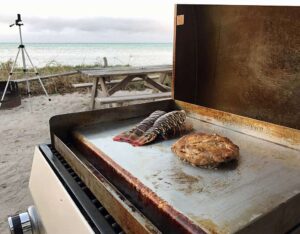
When we used to gather in the Keys for Hobie Cat weekends during lobster season, we would snorkel for lobster in the flats near our motel, then bring our catch back, remove the tail and split the tail in half, baste the meat with butter and garlic and throw it on the grill or griddle.
Don’t overcook the lobster or it will dry out. Baste the meat frequently with butter and garlic, or olive oil infused with spices of your choosing. Cilantro and lime juice are perfect! About 7 minutes on a hot grill, or until the meat is opaque.
Toss the remaining carcass back into the ocean to feed the fish, or crush it up for chum and freeze it. (Better tell mom you put chum in the freezer. I learned that lesson the hard way!)
Boiling Lobster
- Get a large pot of boiling water going, add Old Bay seasoning, and slide the whole live lobster (or just the tail) into the boil head first.
- Turn down the heat and allow the lobster to simmer for 9-12 minutes, or until the lobster’s shell turns red (same as a Maine lobster).
- Break the tail off the body and push or pull the meat out of the shell from the tail end with a fork, or cut the tail in half and scoop it out.
- You can also split the whole lobster in half with a butcher knife, sprinkle with seasoning.
- Brush with butter and lemon juice, or add it to a salad.
Another popular method: Pull it out of the boiling water early, cut it in half, and slap it on the grill for a minute or two until you get grill marks, but don’t overcook.
Freezing lobster tails
Lobster tails can be frozen and kept in the freezer for several months. Some seafood restaurants do just that to extend their lobster menu past the end of the season (March 31).
- Remove the tail and clean the digestive tract by slipping the lobster’s antenna up its butt at the bottom of the tail.
- Wrap it in freezer wrap, or in a plastic freezer bag, and freeze it immediately. I highly recommend adding a dash of water to the bag to keep the lobster from drying out.
- The faster you freeze the tail after removing it from the body, the better it will taste later.
How to cook Florida lobster: Pop’s Fish Market in Deerfield Beach posts this excellent short video on Facebook about how to cook Florida lobster. https://fb.watch/e-fEJB8svR/
Useful resources
Spiny lobster recipes, South Florida SunSentinel (Gift Link)
Florida Lobster recipes on FreshFromFlorida.com, Florida Department of Agriculture.
News you can use
- Mile Marker Guide to the Overseas Highway
- Seafood Festival Calendar
- Legendary Road Food in the Florida Keys
- Our favorite beaches in the Florida Keys
- 11 great kayaking outings in the Florida Keys