
Florida has a remarkable collection of freshwater springs. Even many Floridians haven’t experienced the sparkling clear water, the refreshing 72-degree temperature and the beauty of lush vegetation hugging these rivers of pristine water.
With visitors from Chicago, my husband and I planned a long weekend in March 2026 to re-explore three springs we have kayaked and loved. We wanted to share with our friends what we consider one of the most special experiences in Florida.
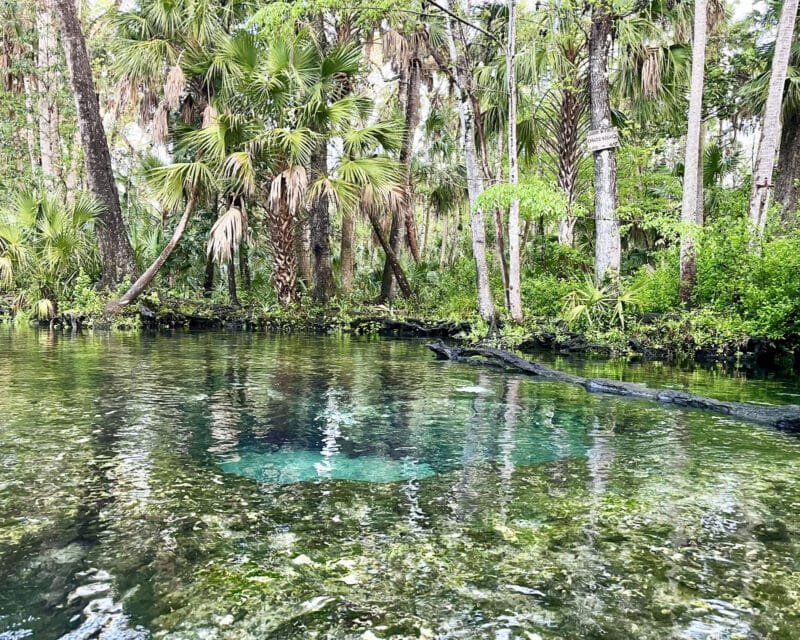
We visited the Chassahowitzka, the Weeki Wachee and Rainbow Springs and the rivers they spawn. All three were beautiful, but something else was clear besides the water: The days of quiet, solitary paddles on these springs, surrounded by only the sounds of birds and nature, are probably over, at least on sunny weekends.
Too many people want to relax and revel in these springs. With Florida’s population growing and development extending into previously rural areas, these springs, all located an hour or two north of Tampa and Orlando, are in danger of being loved to death.
As we experienced these springs and their rivers, we saw how managers of some of these rivers have taken measures to protect the springs, resulting in rules and limitations on visitors, which are often ignored, but which are helping protect some sections of these exceptional places.
All three can still be fantastic experiences, but you do have to time your visit to avoid crowds and set your expectations.
A tale of three springs: Saturday on the Chaz
Our base for the long weekend was an Airbnb on a canal 10 minutes from the most popular spot on the Chaz, Seven Sisters Spring, a cove with a series of rocky underwater caves from which spring waters bubble.
We had visited the Chaz on a weekday a decade ago and we had it all to ourselves. It was magical, with plentiful birds, otters, and a feeling that this was an undiscovered treasure.
On this visit, as soon as we paddled from our rental house’s dock, we spotted an otter diving and swimming – a good omen!
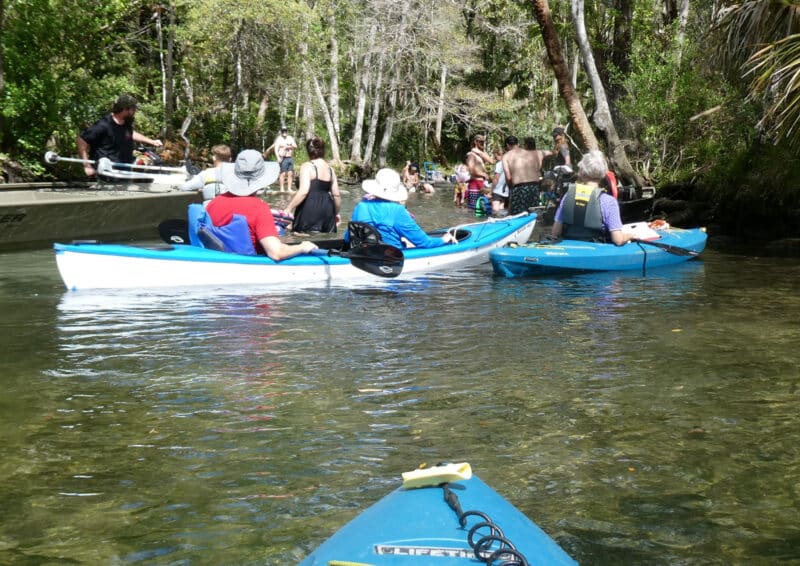
At 10 a.m. on a Saturday morning, however, Seven Sisters Spring was so crowded with powerboats, kayaks, SUPs and swimmers that we couldn’t make our way through the crowd to even see the springs. (We returned at 8 a.m. Sunday to find only a few people and we were able to admire and enjoy what is truly a beautiful spot.)
As we paddled up the river, every sandy spot was occupied by a boat with families playing in the water and blasting their music.
Our Airbnb had a flyer about avoiding activities that degrade the Chaz— getting out of your boat, docking on riverbanks, trampling vegetation, kicking up silt and walking on the points of sand bars. But all these misdeeds were common.
Still, the reason everyone comes here is because it is a place of exceptional beauty, and we enjoyed exploring by kayak.
The Chaz has some especially attractive tributaries as you paddle upstream, and we ventured into the first tributary on our right, Crab Creek, which is the site of a private home (a yoga retreat, I have read).
You can enter the water here if you don’t trespass on the surrounding land. One member of our group left his kayak, dipped into the water and had the whole Crab Creek spring to himself. On this morning, the tide was so low that it was a struggle to paddle over a shallow rocky entrance to the spring, discouraging others.
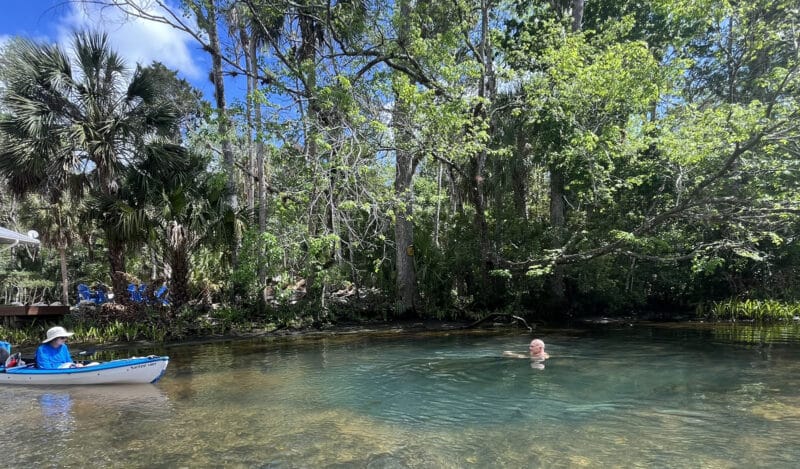
Next, on the left, is the famous Baird Creek, which twists shallow and clear for a 1.5 miles before reaching a popular swimming hole, a spring called The Crack. On a previous visit, we paddled close to The Crack and waded the rest of the way. This time the tide was so low we couldn’t even start up Baird Creek and we decided it was too long to wade. Our tip: Make sure you paddle at high tide to experience this place. On weekends, you are likely to share it with others.
As we continued upstream, the landscape changed from a canopy of hardwood trees to an increasingly saltwater river with primarily palm trees lining it. You can paddle for miles out to the Gulf.
Here’s a complete guide to paddling the Chaz, including launch points, kayak rental information, camping information and other things to do in the area.
Our takeaway: Avoid the Chaz on weekends unless you want to party, swim and be surrounded by people. Otherwise, go early or go on weekdays.
Sunday on the Weeki Wachee: A river combining recreation and preservation
Unlike the Chaz, the Weeki Wachee is a state park and, in recent years, uses of it has been restricted to eliminate the damaging effects of too many visitors.
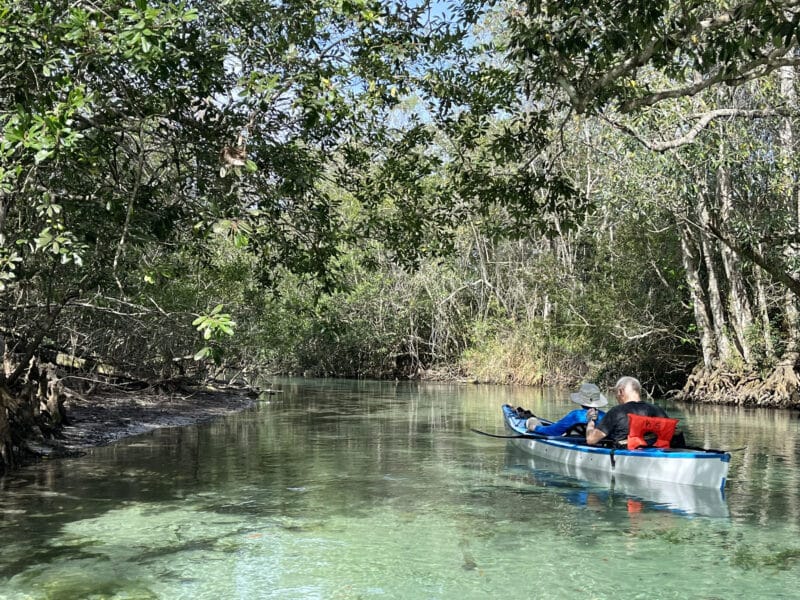
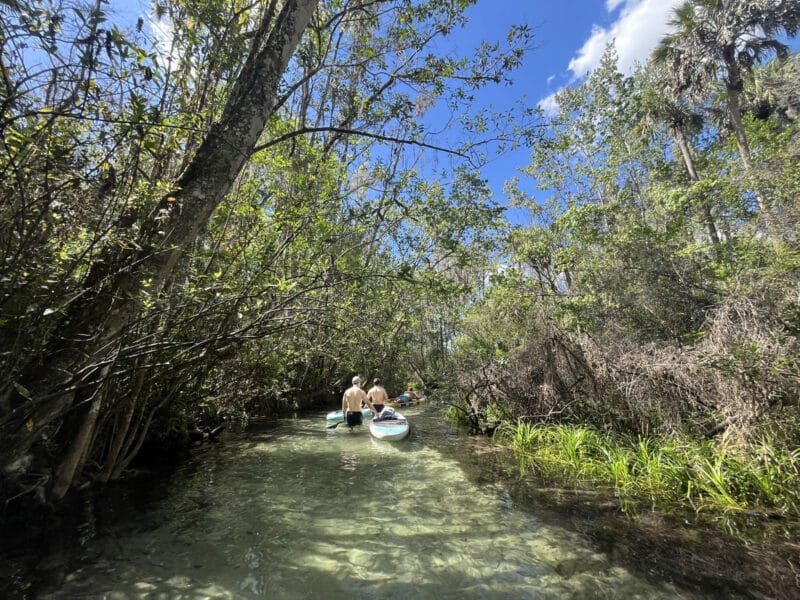
Over the years, my husband and I had paddled twice from Weeki Wachee Springs State Park downstream to Rogers Park. This is a gorgeous blue waterway that is narrow and intimate, enclosing you in a canopy of trees surrounded by lush vegetation.
If you rent kayaks from the park now, you only paddle about 45 minutes to the park’s take-out-point, but this is one spectacular stretch. It is being kept pristine by enforcement of regulations – no disposable items in your kayak (coolers are checked) and no getting out of your boat.
The state park outfitter will livery private kayaks for a fee on this route, but there is no longer livery service back from Rogers Park.
Instead, for a longer paddle, many folks launch from Rogers Park and paddle upstream, then paddle back, and, this time, that’s what we did.
Rogers Park has a beach, restrooms and a boat launch. Note that there is not enough parking for weekend demand; you’ll wait to launch your boat and wait some more for a parking space. Across the river, the Kayak Shop rents kayaks and has its own parking lot. You cannot launch private kayaks from the outfitter’s site.
We rented a kayak and timed the upstream paddle to catch an incoming tide, making it perhaps a bit easier to paddle the first mile or two. Still, the current is strong and you get a workout paddling upstream.
We found the first mile or two of the river to be congested with boats and swimmers. There were houses and businesses along the northern shoreline. Boaters had claimed every sandy spot along the southern shore to moor and swim. Unlike at the Chaz, however, signage had indicated you should not pull your boat onto the sensitive riverbanks and should keep it in the water while you swam. Most people we saw did just that.
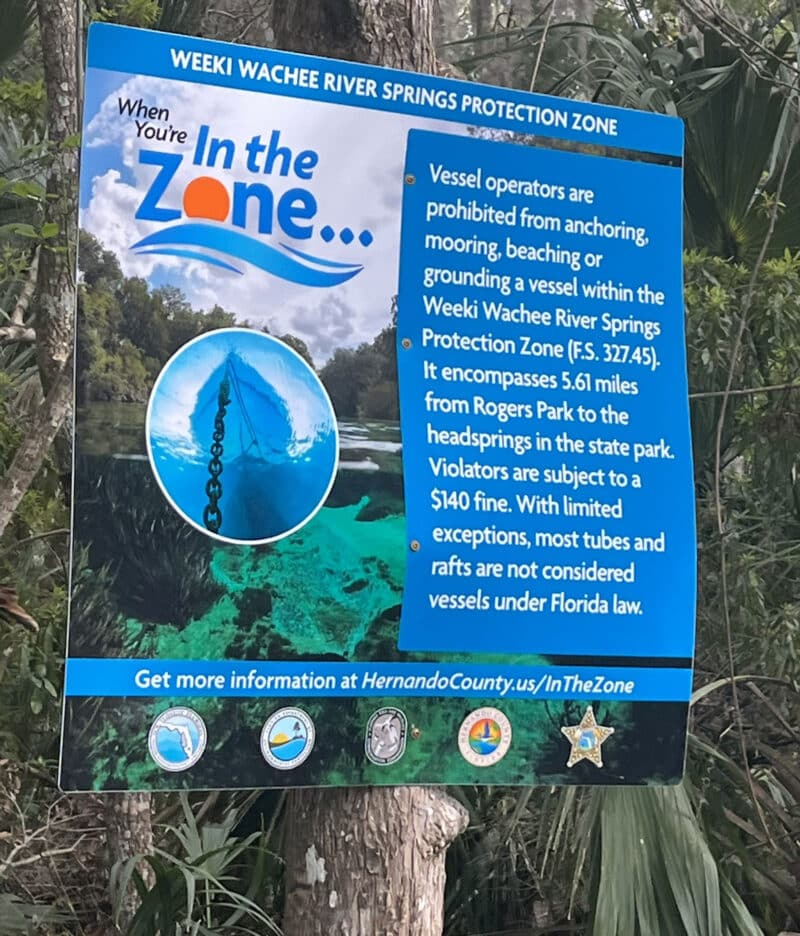
We did see a law enforcement officer cruising on the Weeki Wachee, so there may be consequences to breaking the rules.
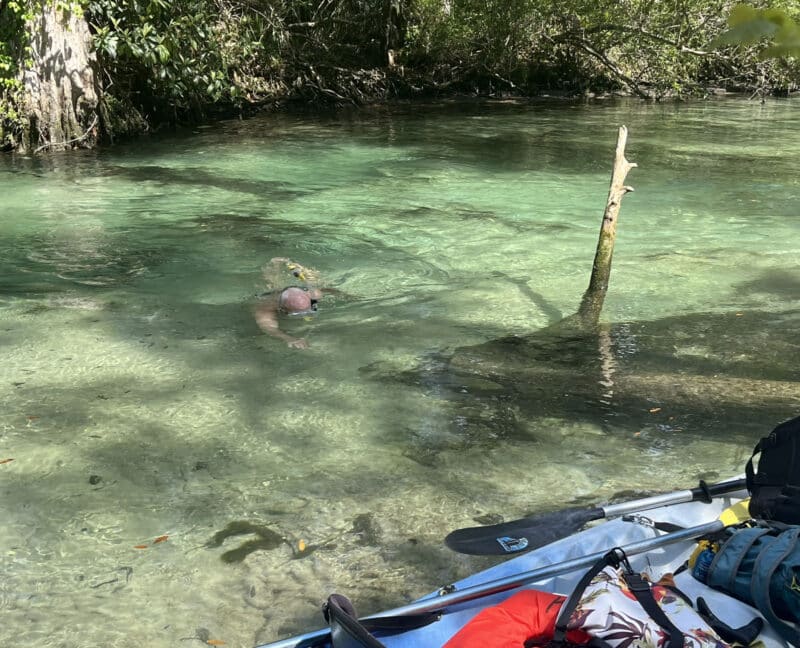
We had hoped to see manatee and, to our delight, we did, floating below our kayak, right in the middle of the most congested area of the Weeki Wachee!
Half-way upstream, the residential area ends, the crowd thins and the scenery is glorious. Here we followed regulations, tied our kayak to a log, swam, waded and ate our picnic. We found this to be the sweet spot for enjoying recreation here – beyond the crowds near Rogers Park but before the more restricted state park.
After stretching our legs, we continued paddling upstream, never reaching the springhead (which you cannot enter) until we had to turn around to return our kayak by 5 p.m.
Here’s a complete guide to paddling the Weeki Wachee River, including launch points, rental information, camping, visiting the state park and other things to do in the area.
Our takeaway: If you want to kayak and swim, the Weeki Wachee is a good choice – just don’t trample the banks or bring your kayak ashore. If you want a short and spectacular float on a section of the river that is the most beautiful, launch from the state park, but be sure to book ahead.
Monday on the Rainbow River: Otters cavort in unbelievably clear water
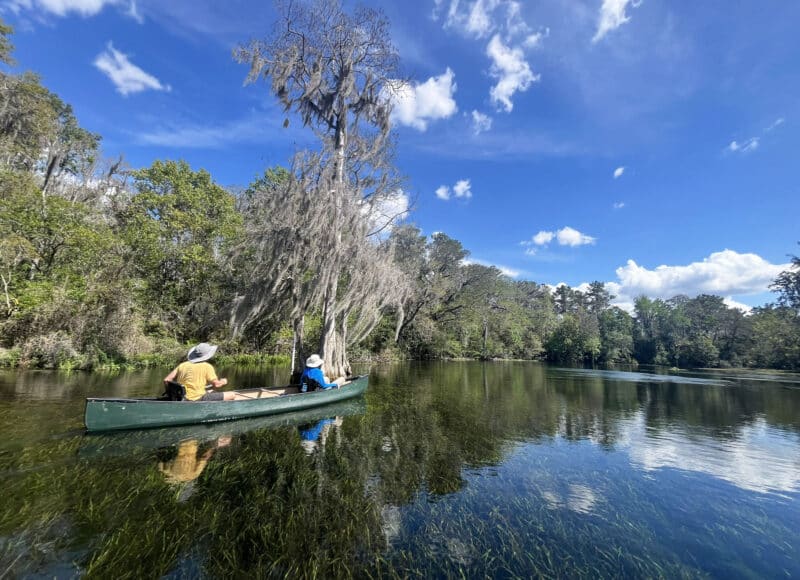
The Rainbow River also originates from a spring in a state park and has extensive regulations protecting it.
My husband and I have paddled the Rainbow before and this river has experienced less change over the last decade than the other two. The Rainbow has few spots to land or swim, which cuts down on the partying, and the river seems to be in good shape. (It’s busy in summer as one of Florida’s top tubing destinations.)
You can rent kayaks at the springhead in the state park for out-and-backs from there. Kayakers who want to spend several hours on the river arrange for a kayak rental and livery service from one of several outfitters in nearby Dunnellon, which allows for hours on the Rainbow. Outfitters transport you to a county facility with a boat dock and kayak launch called KP Hole Park. (There is a separate $10 per-person fee here if you are launching a kayak. This is in addition to rental/livery fee.)
In summer, KP Hole is a key spot to begin tubing on the Rainbow.
Like the Weeki Wachee, food and drink in disposable containers and alcoholic beverages are prohibited.
The float back to where you parked your car with an outfitter is 6.5 miles. You can also paddle one mile upstream to the state park where there is a swimming area, snack bar, trails and more.
While the Rainbow River isn’t a wild river – there are houses along the west bank the entire run – it is an aquatic preserve and is full of wildlife.
It may be the most reliable place to see otters in a Florida river. On two different trips down the Rainbow over several years, we saw multiple otters each time.
On previous visits we missed what may be the best feature of the Rainbow – a scenic stream, where many people tie up their kayaks and wade upstream at narrow, spring-fed Indian Creek. It looks like a scene from Jurassic Park with clear water, a sandy bottom and a fern-filled shoreline.
This creek is just beyond the state park campground, which also has a beach where you can stop to swim and picnic.
Here’s a complete guide to paddling the Rainbow River, including launch points, outfitters, camping, visiting the state park and other things to do in the area.
Our takeaway: The Rainbow is a beauty, but swimming and picnicking on a river is limited. If that’s your goal, it’s best to plan your route to include the state park or its campground beach.
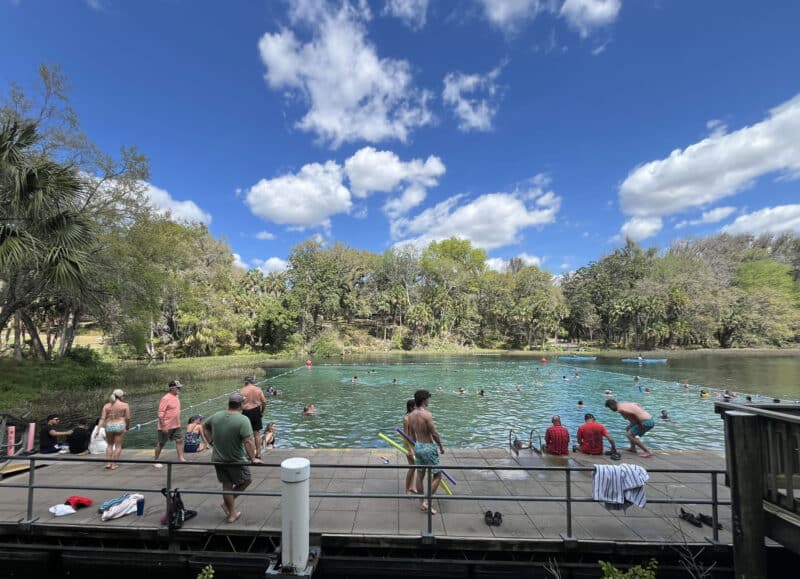
Other options for a “springs break”
Another excellent grouping of springs is around Ocala. Here, you also could paddle three springs in three days –Silver Spring, Juniper Springs Run. and Alexander Springs.
To plan a trip kayaking on the rivers in this article, consult detailed Florida Ramble stories: the Chaz, Weeki Wachee and Rainbow River.